
What Do the April 2026 Maritime Data Tell Us?
In Türkiye's foreign trade, maritime transport plays a vital role in terms of economic growth and global competitiveness. According to the April 2026 data from the General Directorate of Maritime Affairs, the amount of cargo handled at our ports increased by 10.6% compared to the same period of the previous year, reaching 48.2 million tons; this serves as a concrete indicator of growth in this field. This increase not only reflects the expansion of foreign trade volume, but also presents a positive picture in terms of the effective utilization of port infrastructure and the development of logistics capacity.
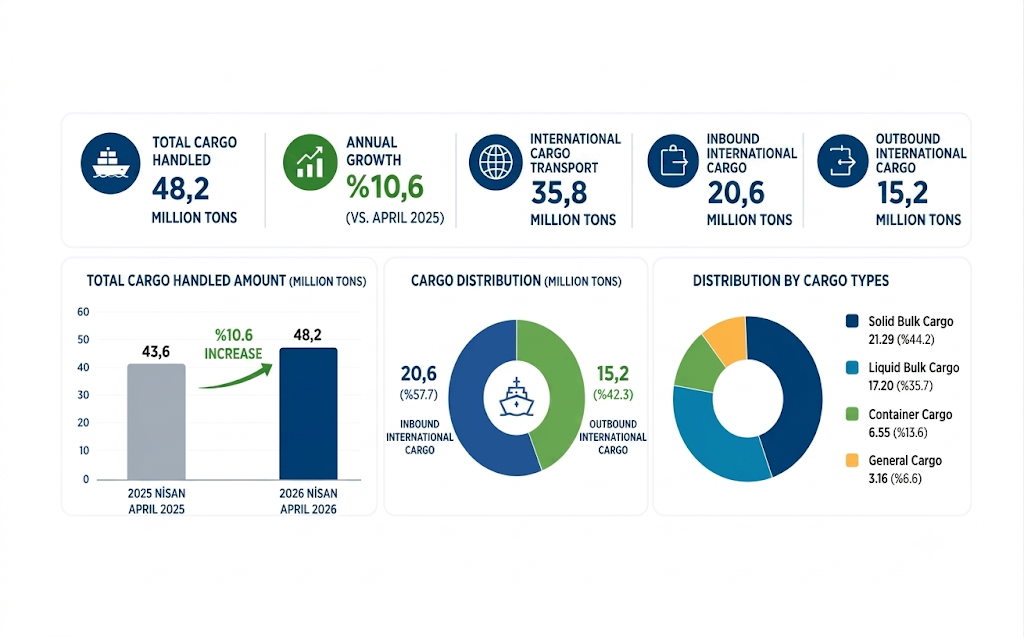
The 8.3% increase recorded in international cargo transport highlights how indispensable maritime transport is for Türkiye in both export and import activities. In particular, the 2.9% increase in outbound cargo and the 11.1% rise in inbound cargo demonstrate that foreign trade dynamics are diversifying and that maritime routes are being used effectively in two-way trade. The remarkable 31.6% increase in cabotage (domestic) transport points to the development of domestic maritime transport and the strengthening of regional trade. This situation reveals that Türkiye has begun utilizing its internal sea routes more effectively and adopting sustainable growth strategies in maritime transport.
Data on cargo types show that product diversity and demand dynamics in foreign trade are directly reflected in port activities. Increases of 23.5% in dry bulk cargo, and 10.9% and 5.5% in general cargo and container cargo, respectively, were recorded. Significant increases, especially in cargoes such as iron ore and concentrates, soybeans, and Portland cement, reflect rising demand in the industrial and construction sectors, while declines in certain cargoes like LNG and fuel oil reflect structural shifts in the energy sector. This diversity demonstrates the dynamic and evolving nature of Turkiye’s foreign trade, while also showing that its ports are able to adapt quickly to these changes.
Evaluated from an impact analysis perspective, the increase in cargo handling capacity at ports strengthens Türkiye’s competitiveness in international trade and enables the acceleration of foreign trade processes. Accelerated import and export operations contribute directly to economic growth and consolidate Türkiye’s position in global trade networks. Furthermore, the share of Turkish-flagged vessels in international cargo transport standing at 6.8% presents an important opportunity area for developing domestic maritime transport. Increasing this ratio should be a strategic target to raise national capacity and reduce foreign dependency in maritime transport. On the other hand, the high share of foreign-flagged vessels demonstrates that Türkiye’s global connectivity in maritime transport remains strong and well-integrated into international logistics networks.
On a port-by-port basis, the fact that the regional port authorities of İskenderun, Kocaeli, and Aliağa hold the highest cargo handling volumes reveals that these regions are critical hubs for foreign trade and logistics. Infrastructure investments, capacity-building projects, and technological developments at these ports directly impact Türkiye’s overall performance in maritime transport.
In conclusion, the April 2026 data clearly highlight the growth dynamics of maritime transport in Türkiye’s foreign trade and the positive impacts of modernizing customs processes. The growing volume of handled cargo, developing digitalization practices, and diversifying cargo types contribute significantly to expanding Türkiye’s foreign trade volume and improving logistics efficiency. While supporting economic growth, these developments strengthen Türkiye’s standing in international trade and provide a solid foundation for sustainable foreign trade strategies.
Link: